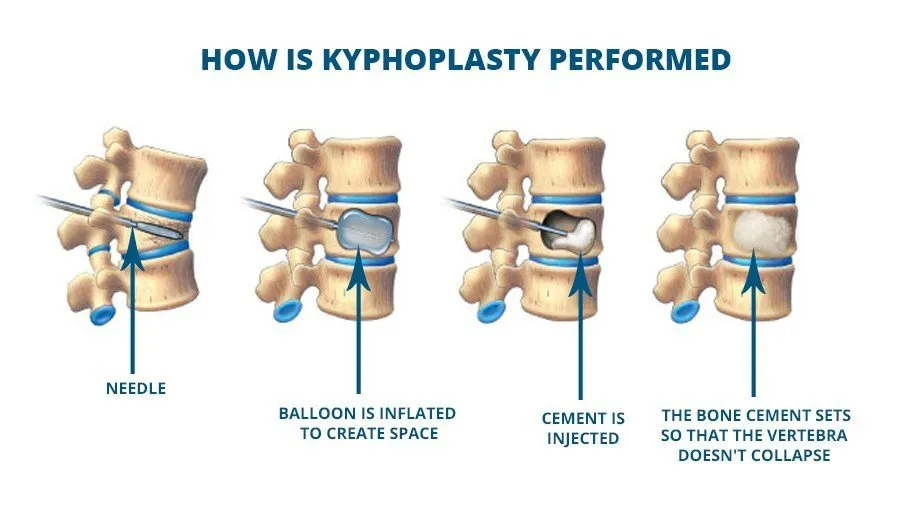
- During kyphoplasty surgery, a small incision is made in the back through which the doctor
places a narrow tube. Using fluoroscopy to guide it to the correct position, the tube
creates a path through the back into the fractured area through the pedicle of the involved
vertebrae.
- Using X-ray images, the doctor inserts a special balloon through the tube and into the
vertebrae, then gently and carefully inflates it. As the balloon inflates, it elevates the
fracture, returning the pieces to a more normal position. It also compacts the soft inner
bone to create a cavity inside the vertebrae.
- The balloon is removed and the doctor uses specially designed instruments under low pressure
to fill the cavity with a cement-like material called polymethylmethacrylate (PMMA). After
being injected, the pasty material hardens quickly, stabilizing the bone.
Kyphoplasty surgery to treat a fracture from osteoporosis is performed at a hospital under local
or general anesthesia. Other logistics for a typical kyphoplasty procedure are:
- The kyphoplasty procedure takes about one hour for each vertebra involved.
- Patients will be observed closely in the recovery room immediately following the kyphoplasty
procedure
- Patients may spend one day in the hospital after the kyphoplasty procedure
Patients should not drive until they are given approval by their doctor. If they are released the
day of the kyphoplasty surgery, they will need to arrange for transportation home from the
hospital.